

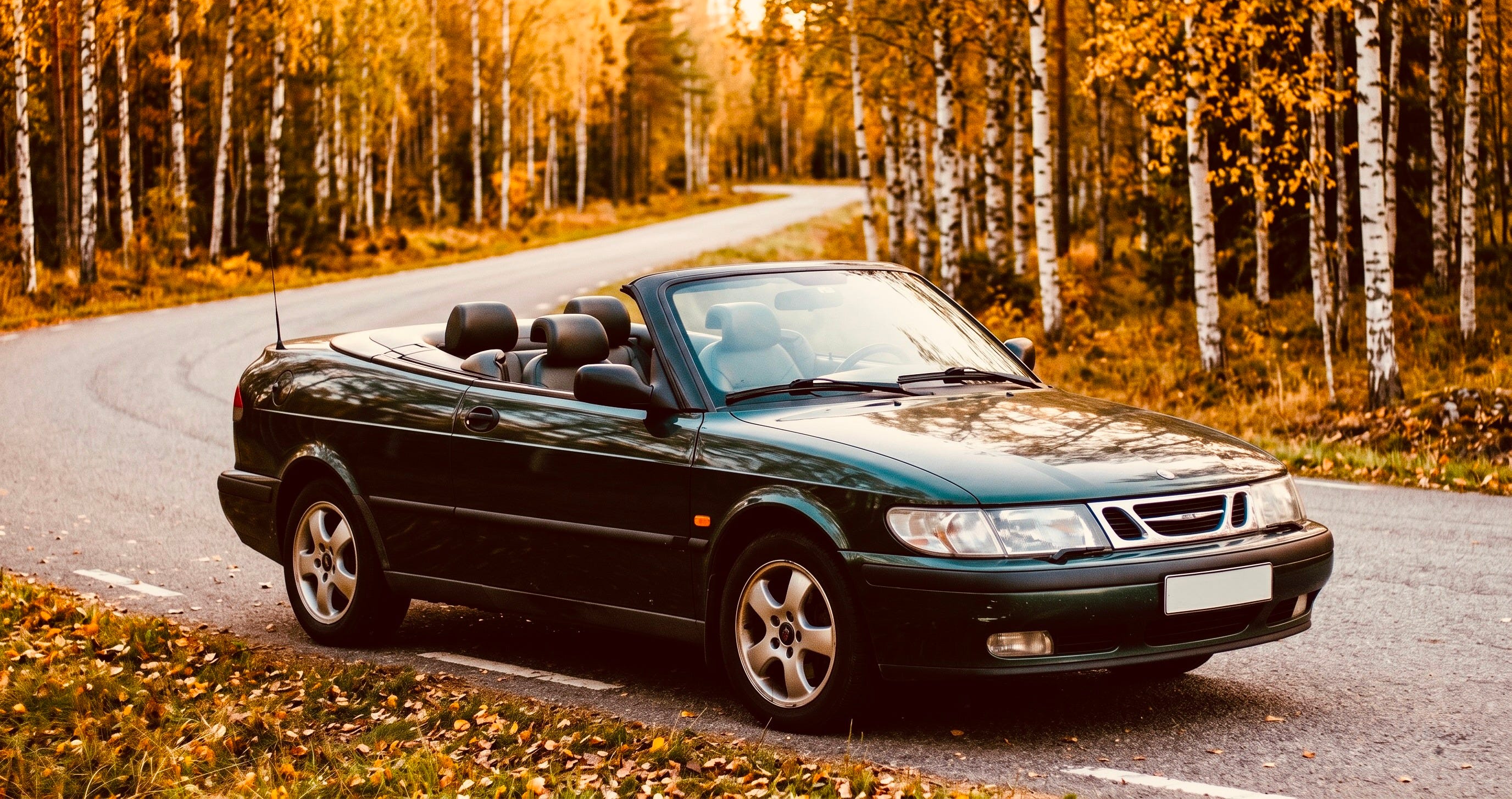
The ignition key is not where you expect it. Not on the steering column where every other car puts it, but down between the seats, next to the handbrake, low and deliberate. First time in a Saab, you reach for the column out of habit and find nothing. Then someone shows you, or you work it out, and after that you never think about it again. It just becomes the way a car starts.
That small disorientation is the whole Saab experience in miniature. The brand was never trying to be difficult. It was trying to be right.
The 9-3 convertible arrived in 1998 and found a buyer that no other car quite reached. Not the BMW crowd, who wanted the badge and the sport pack and the confirmation that they had arrived somewhere. Not the Golf buyer, sensible and slightly reluctant, treating a car as appliance. The Saab buyer was something else: an architect, a doctor, a journalist, someone who had thought about the purchase and decided that what they wanted was a car built by people who also thought. Intelligent without being showy. Individual without making a scene. The kind of person who found the ignition key between the seats and immediately understood why, and felt, privately, that this was a manufacturer worth trusting.
There were easier choices. That was never the point.
Saab had been building aircraft since 1937 before it turned its attention to cars, and it never entirely stopped thinking like an aeroplane company. The dashboard in the 9-3 convertible referenced the cockpit without quoting it directly: clean, purposeful, everything where your hands and eyes naturally go. Hit the Night Panel button and the instruments go dark, the whole cluster extinguished except for the speedometer glowing alone in the blackness. It sounds like a parlour trick until you use it on a long empty road at midnight and realise it is simply correct, the kind of decision only made by engineers who drove their own cars home at night and noticed what bothered them.
The roof was hydraulic, sealing properly in a way that rewarded the body’s careful reinforcement underneath. Valmet built the convertibles in Uusikaupunki, Finland, away from the main production lines, with the kind of attention that volume manufacturing rarely permits. The structure was honest. It did not flex through corners the way lesser open cars do, did not feel like something had been removed from a car not designed for it. The engineering underneath justified the air above your head.
Drop the roof and point it somewhere worth going. The 2.0-litre turbo pulls cleanly from low revs, the boost arriving without drama, the car moving with more purpose than its sensible exterior suggests. This was always Saab’s particular pleasure: the gap between appearance and capability, the satisfaction of a car that did not feel the need to tell you what it could do before it did it. The leather smelled right. The seats held you without making a performance of it. Everything in the right place for the right reason.
Then there is the Viggen.
Named after the Saab 37 Viggen fighter jet, the performance version arrived with a 2.3-litre turbocharged engine producing 230 horsepower, built around a Mitsubishi TD04 turbocharger running significant boost. Zero to one hundred in 6.4 seconds. Front-wheel drive, which at those power levels required both electronic torque management and a certain commitment from the driver, because the physics of the thing were always present and never entirely hidden. You felt what the car was doing. You were expected to do something with that information.
Only 1,305 Viggen convertibles were built.
The person who bought one knew something the market did not yet fully understand: that Saab’s days of building cars on their own terms were ending. GM had acquired full ownership by 2000, and the engineers in Trollhättan could see what was coming. The next generation would run on GM’s Epsilon platform, share engines with the Opel Vectra, carry Saab’s name over a body that answered to Detroit rather than Sweden. The Viggen convertible was made in the last years before all of that fully arrived. A final act of genuine character from a company that had always possessed more of it than the market gave it credit for.
The Saab buyer understood this without needing to be told. They had always been buying a kind of quiet conviction, the belief that a car could be intelligent and warm and honest and not feel the need to prove itself constantly. A car for people who read the footnotes. Who noticed that the key was between the seats and thought: yes, obviously, of course it should be there.
The Trollhättan factory went dark in December 2011 when Saab filed for bankruptcy. The following February, a Saab dealer called ANA completed the final 47 convertibles from cars left unfinished on the assembly line when the lights went out. Thirty-seven of those 47 were Independence Edition models.
That name. Those cars. Completed by hand, from a stopped line, in a factory that had already closed.
Nobody planned for it to end that way. It just happened. And somehow it was exactly right.
The Road & Soul. Cars, cultures, and the road between.