

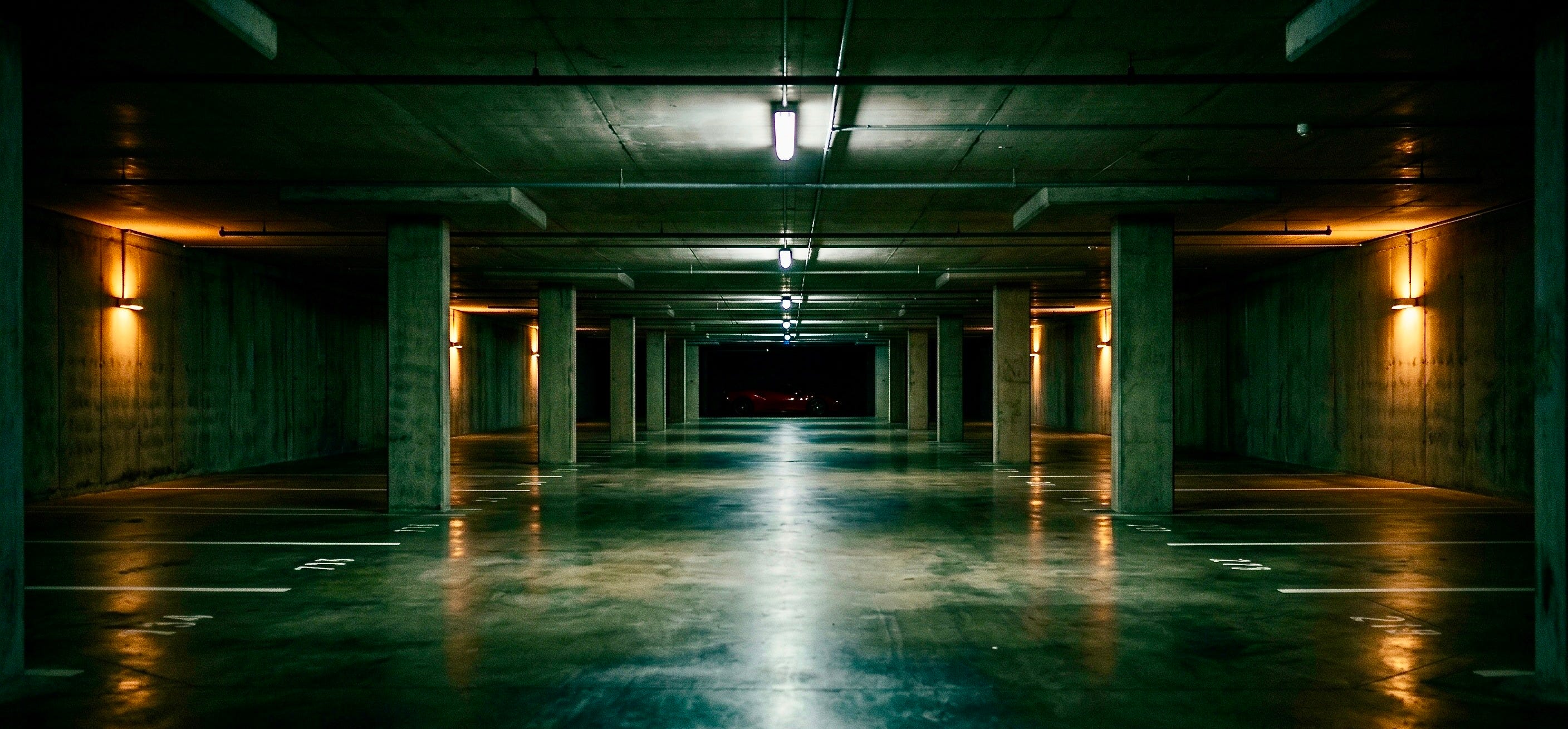
There are rooms beneath certain cities that most people never see.
Not sewers, not service tunnels, not the humming infrastructure of underground trains. These are clean, climate-controlled spaces, lit in sodium yellow, accessible by ramp or by lift, where the air smells faintly of rubber and money and stillness. They sit beneath the expensive postcodes of Munich, Geneva, Zurich, Monaco, Mayfair. Beneath apartment buildings where the lobby has a concierge and the concierge has seen everything. Beneath the kind of addresses that don’t need to announce themselves.
Go down the ramp. Let your eyes adjust.
What you find there is not what the street prepares you for. Not the ordinary civilian machinery of daily life, not the dented Volkswagens and scratch-marked Citroëns that occupy every other car park in the world. What you find is something stranger and quieter. Cars that were built for circuits and mountain passes, for the kind of roads that ask everything of a driver and give everything back. Cars that cost more than most people will earn in a decade, parked in numbered bays, silent, covered sometimes in breathable cotton, waiting in the half-dark for a weekend that may or may not come.
There is something almost melancholic about it. Something that takes a moment to name.
These spaces are where ambition is stored. Where the version of yourself you imagined is kept preserved, like a promise you have not yet broken because you have not yet been tested. The one who takes the long way home, who knows the right road for a Tuesday evening in October, who understands the difference between driving and merely travelling. The car is still here. The intention is still real. Next weekend, perhaps. Next month. When things calm down.
A red Lamborghini sits alone in the corner of one of these rooms. Top up. Engine cold. The wing that held it flat on the Nürburgring at 300 kilometres an hour points at a concrete wall and does nothing. The brakes that could haul it from 200 kilometres an hour to a standstill in the length of a tennis court are cool to the touch. It arrived from the factory with the lap record of the most demanding race circuit in the world already written into its DNA, every component calibrated for the moment everything is asked of it at once. That moment is not today. It has not been today for some time.
Next to it, something low and orange, a McLaren, its colour turned amber by the overhead lights. And beyond that, barely visible in the furthest bay, a Porsche with a wing so large it looks designed for a different purpose entirely, which in a sense it was.
The people who own these cars, are not fools. They are not people who bought without understanding. They know what they have. They have read the road tests, watched the lap times, felt the thing happen on the one occasion they gave it room to happen and came away changed by it, certain that they needed to feel that again. The car represents a self they believe in. Not the self that sits in meetings and answers emails and takes the same road to the same office, but the other one, the one that exists on weekends and in the space between ordinary obligations, the one that was always going to learn the track, always going to take it to the mountains, always going to use it the way it deserves to be used.
The car waits. The car is patient in the way that only machines can be patient, which is to say completely, without longing, without reproach.
There is a kind of city that produces these rooms. You know it when you’re in it. The watches in the shop windows, the restaurants where the menu has no prices on the version given to certain guests, the apartment buildings whose lobbies give nothing away. Money that has been here long enough to become quiet. These cities do not show off. They simply contain, and what they contain, below ground, in the sodium-yellow dark, is this: the evidence of lives that aspired to something and partially arrived.
The car park is not a garage. It is not where these cars live in the way that loved things live somewhere. It is where they wait. The distinction matters. A car that is lived with develops a history, a set of marks and memories, a relationship with its owner that goes beyond ownership. A car that waits develops nothing except dust, and the dust is removed by someone who is paid to remove it.
Come back in a month. The Lamborghini will still be here. Top up. Cold. The wing pointing at the wall. The brakes undisturbed. Outside, the city goes about its business, entirely unaware of what is sleeping beneath it.
Some of the most extraordinary machines ever made are down here. Roads they will never see. Corners they will never be asked to hold. A version of themselves they will carry forever, unused, in the dark.
The Road & Soul. Cars, cultures, and the road between.