

Look at the wheels first. Before the badge, before the bonnet line, before the colour. The wheels will tell you almost everything you need to know about a car, and unlike the rest of it, they cannot lie. A wheel is engineering made visible. It is the one part of the car that has to be honest, because it is the part doing the actual work of holding the whole machine to the surface of the earth.
Most people never look. They see a car and register its shape, its colour, the impression it makes. The enthusiast looks down and slightly inward, at the four points where the thing meets the road, and reads the car from there. The wheels date it. They place it. They tell you what the car was for and how seriously it meant it. They even tell you how well the owner takes care of it, old or new rubber, brake dust or even the painful curb rash on the rim.
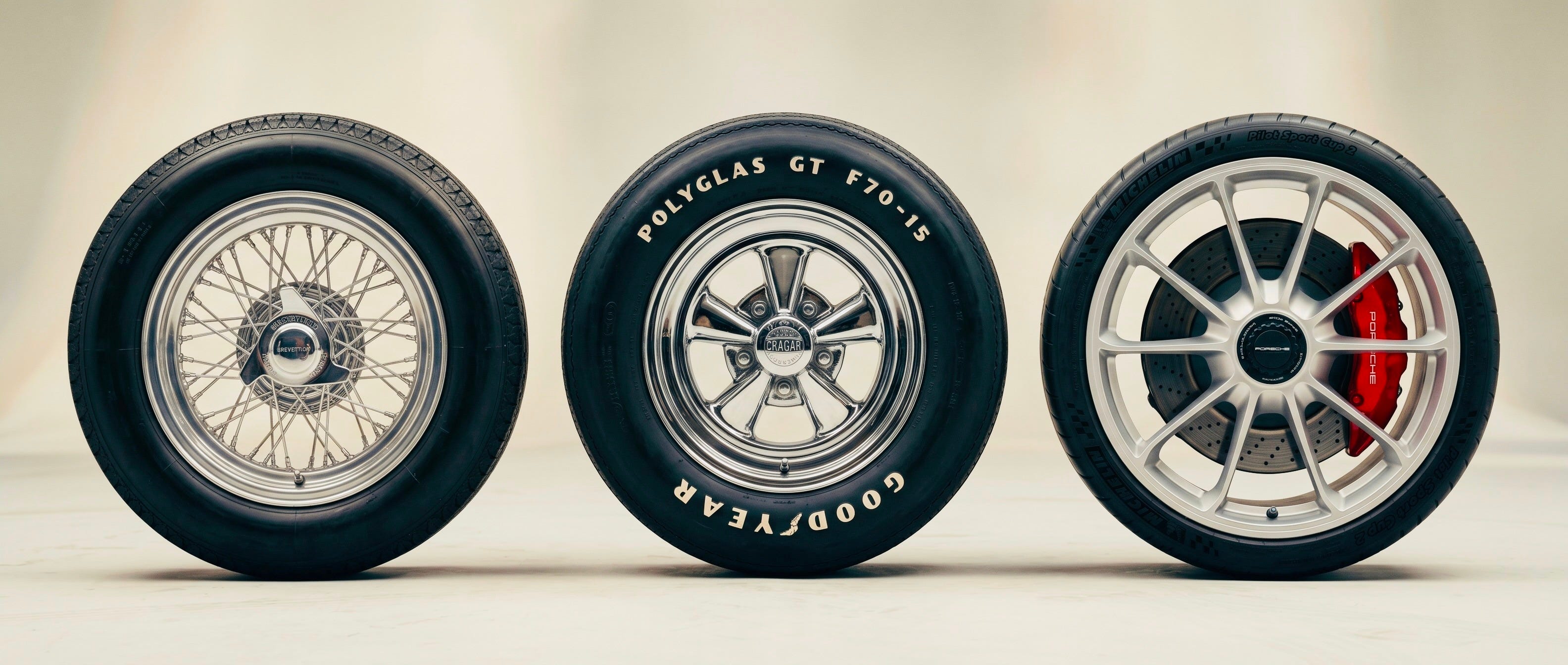
Starting with the oldest style. A prewar racing car wears thin wire-spoke wheels with a single large nut at the centre, often winged, sometimes with two or three protruding ears. These are knock-offs, and they are one of the great elegant solutions in the history of the motor car. The centre lock hub was patented by the British firm Rudge-Whitworth by 1908, a single central fastener replacing the ring of nuts that held an ordinary wheel. You tightened it, or loosened it, with a sharp blow from a soft hammer, which is where the name comes from. By 1913 the system was universal in Grand Prix racing, because a single nut comes off faster than five, and races are won and lost in the pit lane as much as on the circuit.
There is real beauty in this. The thing that makes a knock-off wheel look romantic, the winged spinner catching the light at the centre of a spoked wheel, exists for an entirely practical reason. It was never decoration. It was speed.
In 1922 an Italian by the name of Carlo Borrani licensed the Rudge-Whitworth design and began making wire wheels with aluminium rims rather than steel, lighter, reducing the unsprung mass that a car carries at each corner. Borrani wheels went on to define the look of an entire era of beautiful cars. Alfa Romeo, Lancia, Maserati, and after the war, Ferrari. When you picture a 1950s sports car, a Mille Miglia car, something silver or red on a mountain road, you are picturing Borrani wire wheels. The chrome spokes laced in their dozens to a polished centre. The single spinner. An object that was the cutting edge of competition technology and is now shorthand for a kind of lost glamour.
The wings didn’t survive. In the late 1960s, safety regulations in the United States and West Germany turned against the protruding ears of the knock-off spinner, which were judged a danger to pedestrians. America banned them on road cars in 1968. The James Bond association, the spinning blades that the films loved, did the cause no favours. Manufacturers kept the elegant single nut principle but replaced the winged spinner with a plain hexagonal nut, and the look quietly changed. Function had created the romance, and a change in function took part of it away again.
Then look at an American muscle car. Chrome wheels, deep dish and bright, wrapped in tyres with the classic raised white lettering on the sidewall. Radial T/A in white against the black. This is a completely different philosophy expressed through the same four corners. Where the European wire wheel was about lightness and the quick change, the American wheel was about presence, about width, about a tyre that announced its brand and its purpose in capital letters you could read across a car park. It was about strength, size and the ability to carry weight, while putting all those horses down to the tarmac. The wheel tells you the car came from a culture that valued the statement as much as the speed. Neither approach is wrong. They are different romances.
Move to the modern era and the wheels have changed again. Now it is a contemporary Porsche wearing a centre-lock wheel with a single large nut, and the circle closes. The thing that began as a Rudge-Whitworth quick release for wire wheels in 1908 is now found on the most advanced sports cars in the world, for exactly the same reason it always existed: one nut comes off faster than five. The wheels are forged, intricate, multi-spoked, often with a brightly coloured brake caliper visible behind them, acid green, bright yellow or red, telling you the car has a serious braking system and wants you to know. The reasoning has changed to that of the original purpose, one could possibly say more form over function.
Here is something most people do not know, and it lives in the tyres rather than the wheels.
For a brief period in the late 1970s and 1980s, Michelin built a tyre called the TRX, and it was a genuinely brilliant idea that the world declined to adopt. Michelin had worked out that a tyre and its rim performed better when designed together as a single system rather than the tyre being made to fit a standard wheel. The TRX rim had a different, flatter flange, which let the sidewall flex in a smoother curve and allowed a lower-profile, higher-performance tyre without sacrificing ride comfort. There was one problem, or rather one deliberate decision. To stop anyone fitting a TRX tyre to an ordinary wheel, which would have been dangerous, Michelin sized the TRX in millimetres rather than inches. A normal wheel might be fifteen inches. A TRX wheel was 390 millimetres, or 415, sizes that physically would not accept a conventional tyre and could not be fitted to a conventional rim.
The engineering was ahead of its time. Ferrari used the 415 millimetre TRX on the Testarossa and the Boxer. BMW used it on the M635CSi. Saab, Renault, Citroën, Peugeot, even Ford, who put it on the Mustang. For a moment it looked like the future.
It was not the future. The very thing that made it clever, the bespoke metric sizing, killed it in the end. When the tyres wore out, owners discovered that TRX rubber was rare and expensive and getting rarer, and that nothing else would fit their wheels. Many threw the beautiful TRX wheels away and fitted ordinary ones. Michelin stopped making most of the sizes. Today, an original car still running on its correct TRX tyres is a sign of an owner who refuses to compromise, who is willing to pay for rare rubber to keep the car exactly as it left the factory. The wheel, once again, tells you the character of who owns the car.
This is what the wheels are doing, on every car, all the time. They are telling you the truth. The era, the intention, the engineering philosophy, the country, the owner’s priorities. A spoked wheel with a winged spinner is a different statement to a chromed muscle car rim, which is a different statement to a forged centre-lock with giant carbon brakes nestled behind it. But all three are answers to the same question, which is how to connect a machine to the road and how to feel about that connection.
Look down. It is all there.
The Road & Soul. Cars, cultures, and the road between.