

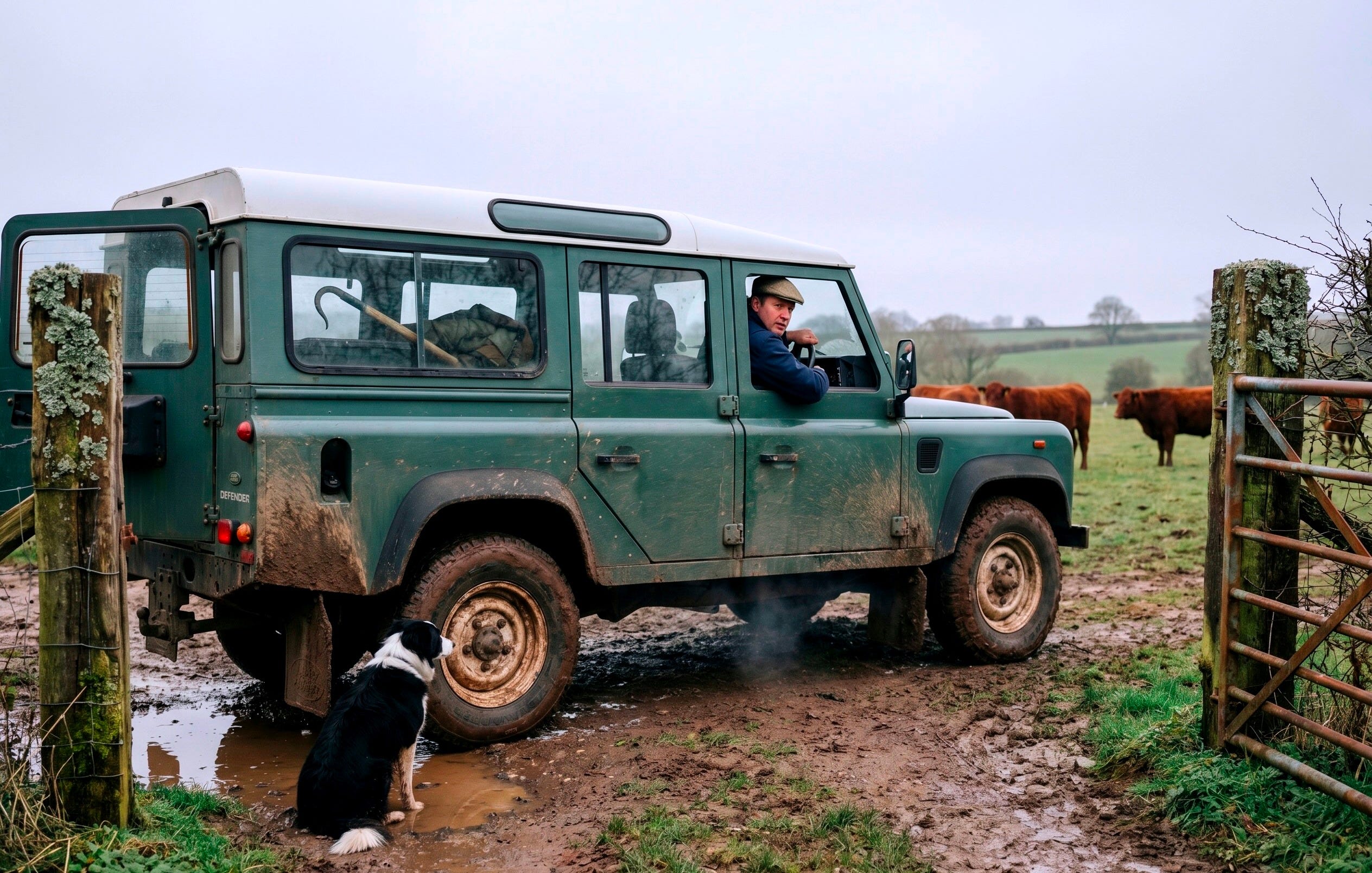
A Devon farmer reverses a Defender 110 through a gate he has never measured because he has never needed to. The mud on the sills has been there since Tuesday. There is a bale hook on the back seat. The engine, a 300Tdi diesel, knocks and shudders at idle the way it has knocked and shuddered for two hundred thousand miles: with the obligatory oil leak, on its own schedule, and without caring very much about yours. The farmer does not think about the car. This is the highest compliment available.
In Lagos, the same car means something entirely different.
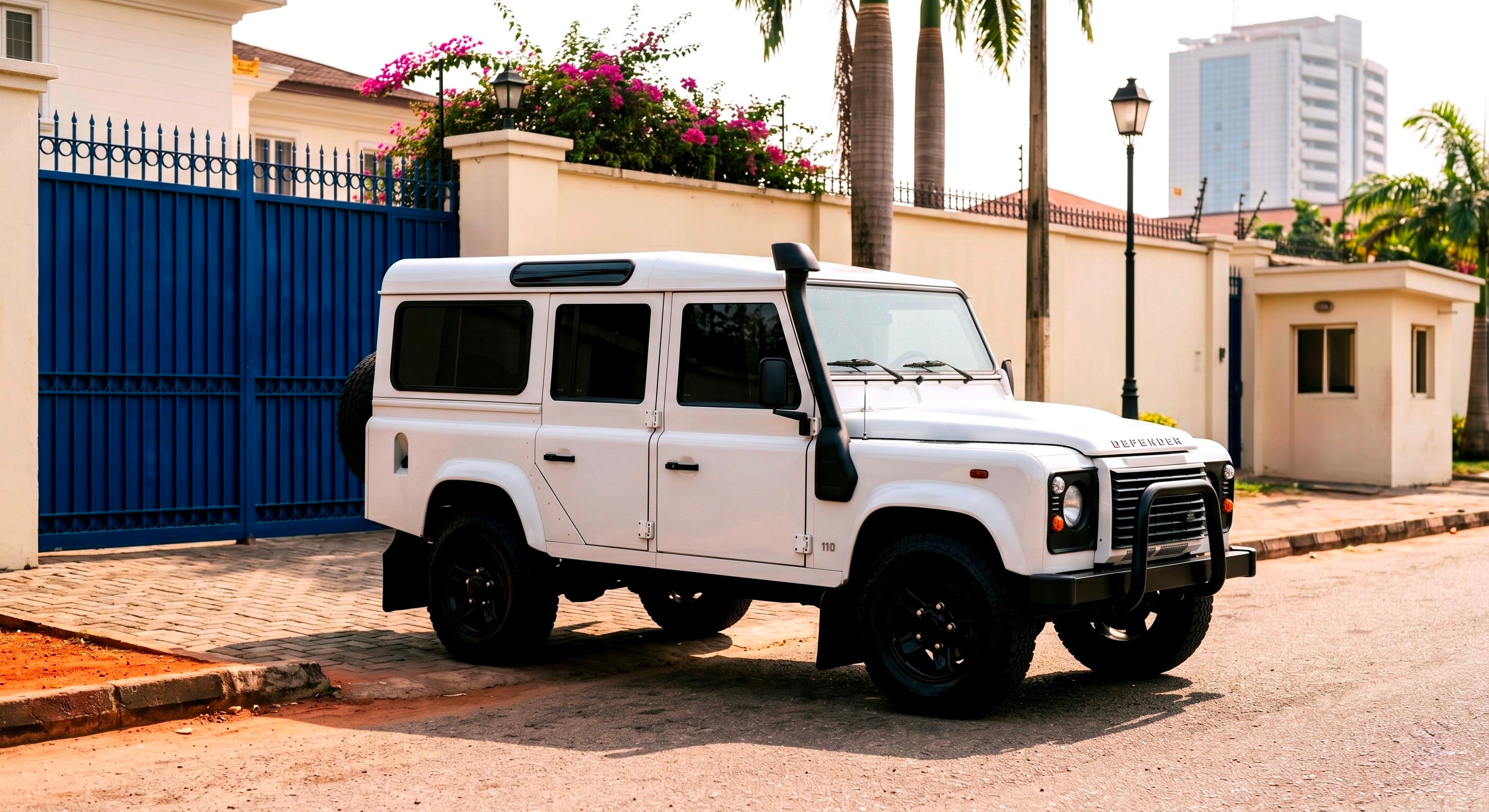
A white Defender 110, high-spec, sits outside a compound with a blue gate in Victoria Island. It has been detailed this morning. The alloys are clean. Someone chose this car carefully, not because it was the most practical option available, not because nothing else would do the job, but because of what it says before anyone gets out of it. It says: I have arrived. Not quietly, not apologetically, but with four-wheel drive and a wheelbase that does not negotiate with the road. In a city where the roads do not negotiate with anything, this matters. The Defender here is not a tool. It is a statement, and the statement is understood by everyone who sees it.
Then there is America.
Maurice Wilks sketched the original Land Rover concept in the sand at Red Wharf Bay in Anglesey in 1947, needing a replacement for his ageing wartime Jeep. What he drew became the Series I, launched at the Amsterdam Motor Show on the 30th of April 1948 for £450. A farm vehicle. Explicitly, unapologetically, entirely a farm vehicle. The aluminium panels were chosen because steel was rationed after the war, not because anyone was thinking about weight savings. The body-on-frame construction was agricultural in the most literal sense. It was designed to work, to be fixed when it broke with whatever was to hand, and to start again the next morning.
For almost forty years, Land Rover made exactly this car. Iterating slowly, adding coil springs in 1983, formalising the Defender name in 1990 when the Discovery arrived and Land Rover needed to tell them apart, but never straying far from the original proposition. The world’s difficult terrain became its natural habitat: the savannahs of East Africa, the highlands of Papua New Guinea, the marshes of rural England. Military forces bought it. Aid organisations relied on it. Farmers tolerated its moods, carried spare parts in the back, and kept driving. The relationship between a working Defender and its owner is less romance than negotiation. It will get you there. On its own terms.
America barely knew it existed.
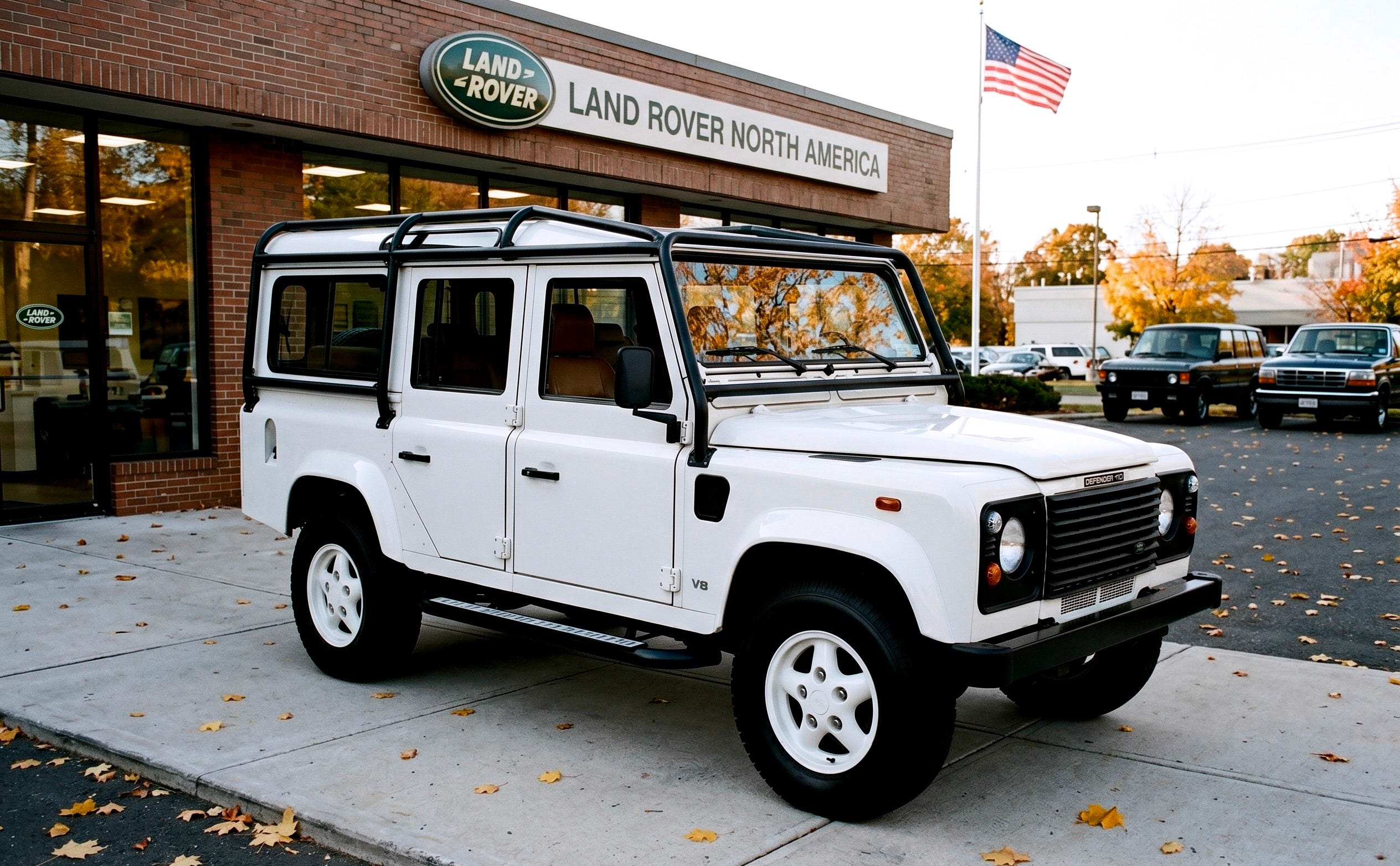
Land Rover sold what became known as the North American Specification Defender from 1993 to 1997, a version modified to meet US safety and emissions regulations, fitted with a 3.9-litre Rover V8 and air conditioning, because America. They sold 7,059 of them in five years before the cost of compliance became too high and Land Rover pulled the plug. The Defender disappeared from American showrooms and did not return officially until the redesigned 2020 model arrived on a completely new platform.
Those 7,059 original NAS Defenders became, over time, something extraordinary. Not because they were better than the European versions, but because there were so few of them. In a country where the Defender had no history, no working context, no tradition of mud and bale hooks and oil leaks and Tuesday, it arrived as pure mythology. The Defender as idea rather than the Defender as tool. Restoration shops in Tennessee and Colorado began importing and rebuilding classic examples, selling them for prices that would make the Devon farmer quietly incredulous. Today a well-restored original Defender commands upwards of a hundred thousand dollars in the American market. Some considerably more.
The same car the Devon farmer does not think about.
What the three countries reveal is how completely an object can be rewritten by the place it lands. In England the Defender carries the weight of agricultural history, of muddy purpose, of a thing that starts most mornings and gets fixed on the others. In West Africa it is the physical evidence of success, a car chosen for visibility as much as capability, understood immediately by everyone who sees it as a signal of standing in a world where such signals are read carefully. In America it is a collector’s object, a piece of imported mythology, a car that has been loved precisely because most Americans never had the chance to live with its faults.
Maurice Wilks drew it in the sand because he needed to get to the farm.
Nobody expected it to end up here.
The Road & Soul. Cars, cultures, and the road between.