

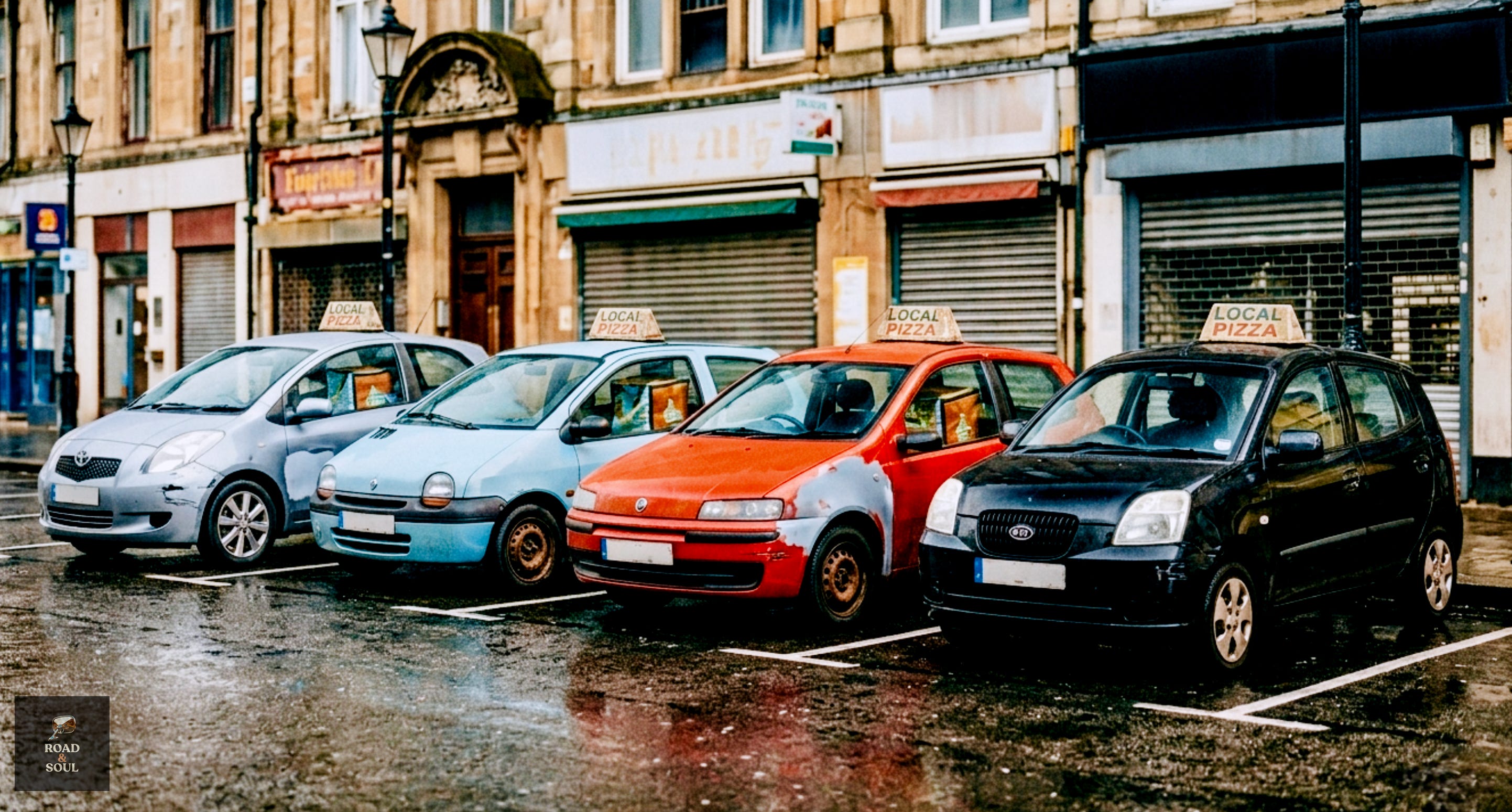
Somewhere in your city, right now, there is a Toyota Yaris with 190,000 kilometres on it doing something no Ferrari has ever been asked to do. It is on its fourth set of tyres and its third set of brake pads. The interior smells of oregano and warm cardboard. There is a magnetic sign on the roof. It has been started and stopped forty times tonight already, parked half on kerbs at angles that would make a driving examiner wince, left idling outside apartment buildings in the rain while someone on the third floor decides whether to tip. It will do the same thing tomorrow. And the night after that.
Nobody writes about these cars. Nobody restores them. Nobody photographs them at dawn on empty mountain roads.
They should.
Consider what the job asks of them. Delivery driving is the automotive equivalent of a stress test that never ends. Short trips in heavy traffic are the worst possible duty cycle for any engine: the oil never fully warms, the clutch never gets a rest, the brakes applied and released and applied again in a rhythm that would wear out lesser machinery in months. Add to this the fact that the cars doing this work are old, bought cheaply, maintained minimally, and kept going by a combination of necessity and mechanical stubbornness. A car that survives five years of pizza delivery has earned something that no amount of careful weekend motoring can replicate.
It has survived.
The Renault Twingo is one of these cars, or was, in its first generation. Small, French, and completely unbothered by its own charm, the original Twingo ran from 1992 to 2007 on a 1.2-litre engine and a design so eccentric it became lovable despite itself. The single-piece interior, the sliding rear bench, the dashboard that looked as though it had been designed by someone who found conventional car interiors mildly exhausting. It was not a car that took itself seriously, and this turned out to be exactly right for a machine that would spend its working life being parked badly outside takeaways. Twingos did not break down because there was very little inside them complicated enough to break.
The Fiat Punto made the same argument differently. Where the Twingo was idiosyncratic, the Punto was straightforward and Italian in a way that meant it looked better than it needed to and drove with more willingness than the job required. You can still find early Puntos in southern European cities doing delivery work, their paintwork faded to something approximating their original colour, interiors stripped back by years of use to the components that actually matter. They persist. Not despite their age but almost because of it: the simplicity of older small cars means there is less to go wrong, and what goes wrong is usually fixable with modest parts and modest labour.
Then there is the Kia Picanto. A car that arrived in Europe in 2004 from a manufacturer still finding its footing in the Western market, priced at the point where a student or a recent graduate could actually afford it. Kia at that time was not selling aspiration. It was selling honesty: here is a small car, it will start every morning, it will not cost you very much to run, it makes no promises it cannot keep. The Picanto delivered on this with a completeness that surprised people who had not expected to be surprised by a Kia. Delivery companies and individual drivers found it could absorb the punishment of city work and return the next day ready to absorb more.
They still do.
And then the Toyota Yaris. If the delivery car world had a patron saint, it would be the Yaris, the first and second generation models that are now old enough to be invisible and reliable enough to still be working. Toyota built it to last in the most unglamorous sense: every component engineered to a standard of durability that competitors sometimes chose not to match. The 1.0 and 1.3-litre engines in these cars are fundamentally uncomplicated. They do not have the complexity that creates the failure modes that create the repair bills that end working lives prematurely. A Yaris at 200,000 kilometres is not a noteworthy event. It is a Tuesday.
What connects all of these cars is the thing car culture rarely celebrates: the quality of being dependable without being exceptional. We talk about performance in terms of speed, or handling, or the feeling a car gives you on a good road with nobody else on it. We rarely talk about performance in terms of starting every morning for twelve years regardless of how it was treated the night before. But this is also a kind of performance, and in some ways it is the more demanding one, because it asks for consistency rather than brilliance, and consistency is harder to manufacture than moments of greatness.
The drivers of these cars have their own relationship with them that the automotive press has never had much interest in. A delivery driver who has put 80,000 kilometres on a Yaris in two years knows that car the way a weekend enthusiast knows a cherished classic. They know the rattle that started in January and stopped in March without explanation. They know which gear to use on that hill. They know the heater takes four minutes to work properly and they have adjusted their expectations accordingly. It is not romance, exactly, but it is something close to it: the intimacy that comes from depending on a machine, night after night, to keep its side of the arrangement.
These cars will not appear in auction catalogues. Nobody is restoring them to concours condition in a heated garage.
But somewhere tonight, in the rain, with a deadline and a bag of food that needs to arrive warm, a first-generation Yaris with three previous owners and a wing mirror held on with tape is doing the thing it was built to do. Quietly, reliably, without ceremony or complaint.
That is not nothing. In fact it is quite a lot.
The Road & Soul. Cars, cultures, and the road between.