

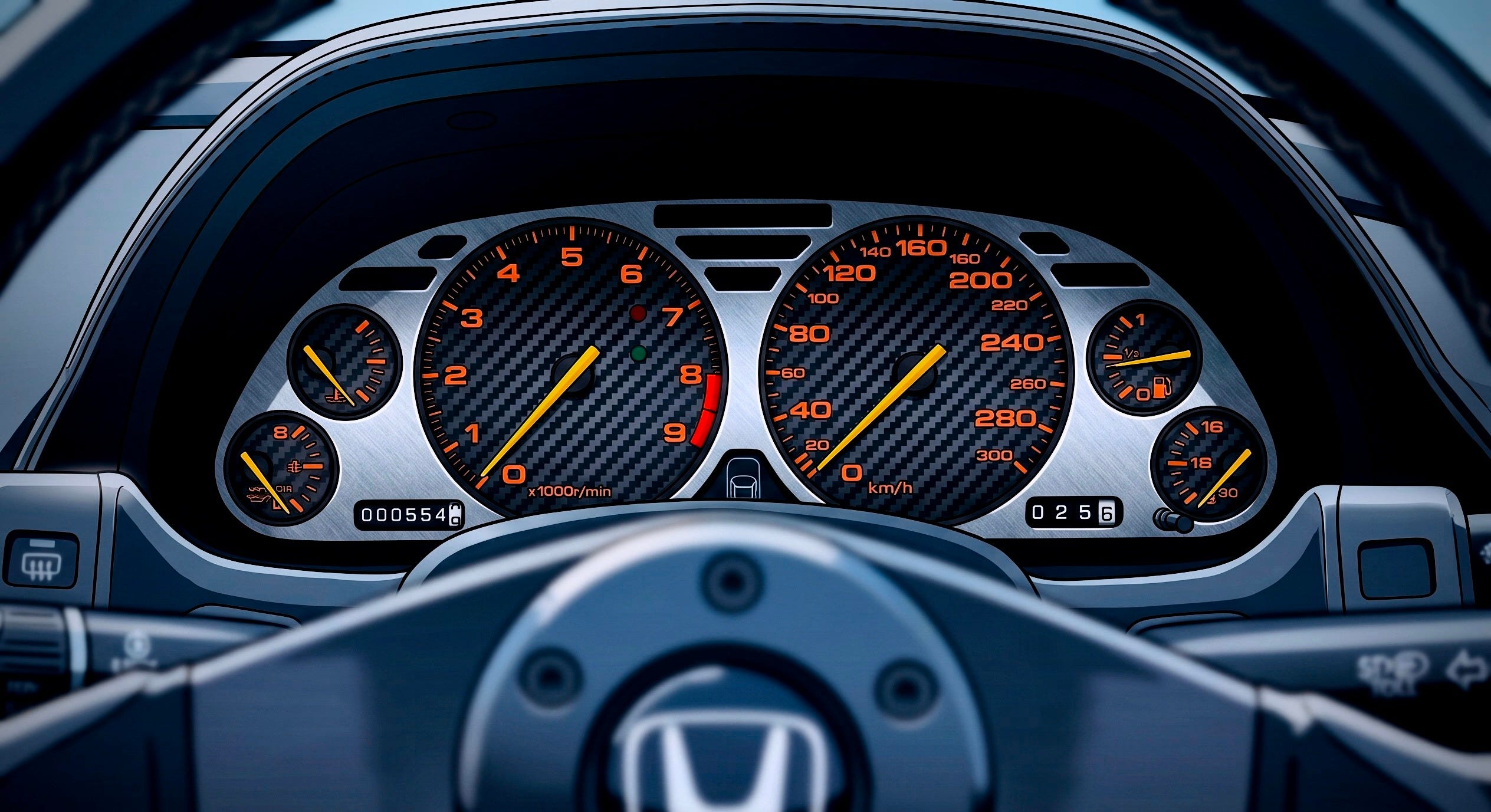
Open the door of a first-generation Honda NSX and the first thing you notice is how little there is. White-faced instruments, thin-rimmed wheel, seats that hold you rather than cradle you. No wood. No chrome flourishes. A cockpit that communicates one thing clearly: this car was built for driving, and it expects you to know that already.
That aesthetic is not an accident. It is not minimalism in the fashionable sense, the kind that mistakes emptiness for sophistication. It is something more purposeful. The Japanese manufacturers who built these cars were communicating a set of values about what a car is for and what the person driving it is expected to do with the information being provided. The cockpit exists to serve the driver. The driver is assumed to know what the information means.
Honda began development of the NSX in the mid-1980s, led by chief engineer Shigeru Uehara, with a brief that would have paralysed most manufacturers: build a supercar that a skilled driver can use fully, without the drama and difficulty that European performance cars of the period treated as features rather than flaws. Ferrari and Porsche made machines that demanded a kind of submission from their drivers. The NSX decided this was unnecessary.
The cockpit was designed with an F-16 fighter jet as its reference point. Not aesthetically, but functionally. Every control placed within reach without searching. Every gauge legible at speed. Honda called this the Human Support Cockpit, and it meant exactly what it said. Not the car as showpiece. The car as instrument.
What you get, sitting in one today, is a dashboard that still feels resolved in a way many modern cars do not. It does not have the handmade leather and walnut of the Italians, nor the over-instrumented seriousness of the Germans. It has clarity. The instruments are where they should be. The information arrives in the correct order of priority. Thirty-five years later, nothing feels wrong.
The engineering runs to the same logic. The NSX was the world’s first production car with both an all-aluminium body and an all-aluminium engine block. Honda used titanium connecting rods not because they were cheaper or easier to manufacture but because they lowered reciprocating mass and allowed the 3.0-litre VTEC V6 to reach 8,000 rpm. Every decision had a reason. Every reason pointed in the same direction. Ayrton Senna tested the car at Suzuka during development and worked directly with the engineering team on the handling. The NSX that went on sale in 1990 carried his input in the way it communicates through a corner. Gordon Murray, designing the McLaren F1 shortly afterwards, cited it as the car that showed him what was possible.
That is how Japanese precision works at its best. It does not announce itself. It demonstrates.
The same philosophy runs through the genre in smaller ways. The instrument clusters of the Nissan Skyline GT-R, the Mazda RX-7, the Honda S2000, are all variations on the same idea. Information, legibly presented, without editorialising. A high redline given room to breathe on the tachometer face because it is the number that matters most in these cars and everyone involved knew it. The oil temperature gauge present as standard, not an optional extra, because the engineers assumed the driver cared about such things. Interiors designed by people who drove.
The aftermarket built an entire culture around this clarity. Gauge manufacturers like Defi produced additional instrument pods in the same aesthetic language as the factory clusters: small, white-faced, designed to sit on the dashboard pillar or centre console without visual conflict. You wanted more information; here is more information, presented the same way as the information you already have. There was a coherence to it the equivalent European aftermarket culture never quite achieved. The Japanese tuning aesthetic is often misread as decoration.
It is about data.
Where the Europeans made things from emotion, the Japanese made things from discipline, and the results carry as much feeling as anything from Stuttgart or Maranello. Just differently. A Ferrari speaks loudly about what it is. The NSX, the GT-R, the FD RX-7 speak quietly and expect you to listen. The dials tell you what the engine is doing. The chassis tells you what the road is doing. The car assumes you will do something useful with both pieces of information, and it does not have time to explain itself.
There is a generation of drivers who came to these cars through screens: Gran Turismo at first, then video footage, then the secondary market for imported examples that arrived in European and American driveways years after they were built. What they found, when they finally sat in one, was a cockpit that already made sense. Because the Japanese manufacturers had designed them that way from the beginning. Not for a driver in a country, but for anyone who paid attention.
The dials are still telling you something. The question is whether modern cars have the confidence to do the same.
The Road & Soul. Cars, cultures, and the road between.