

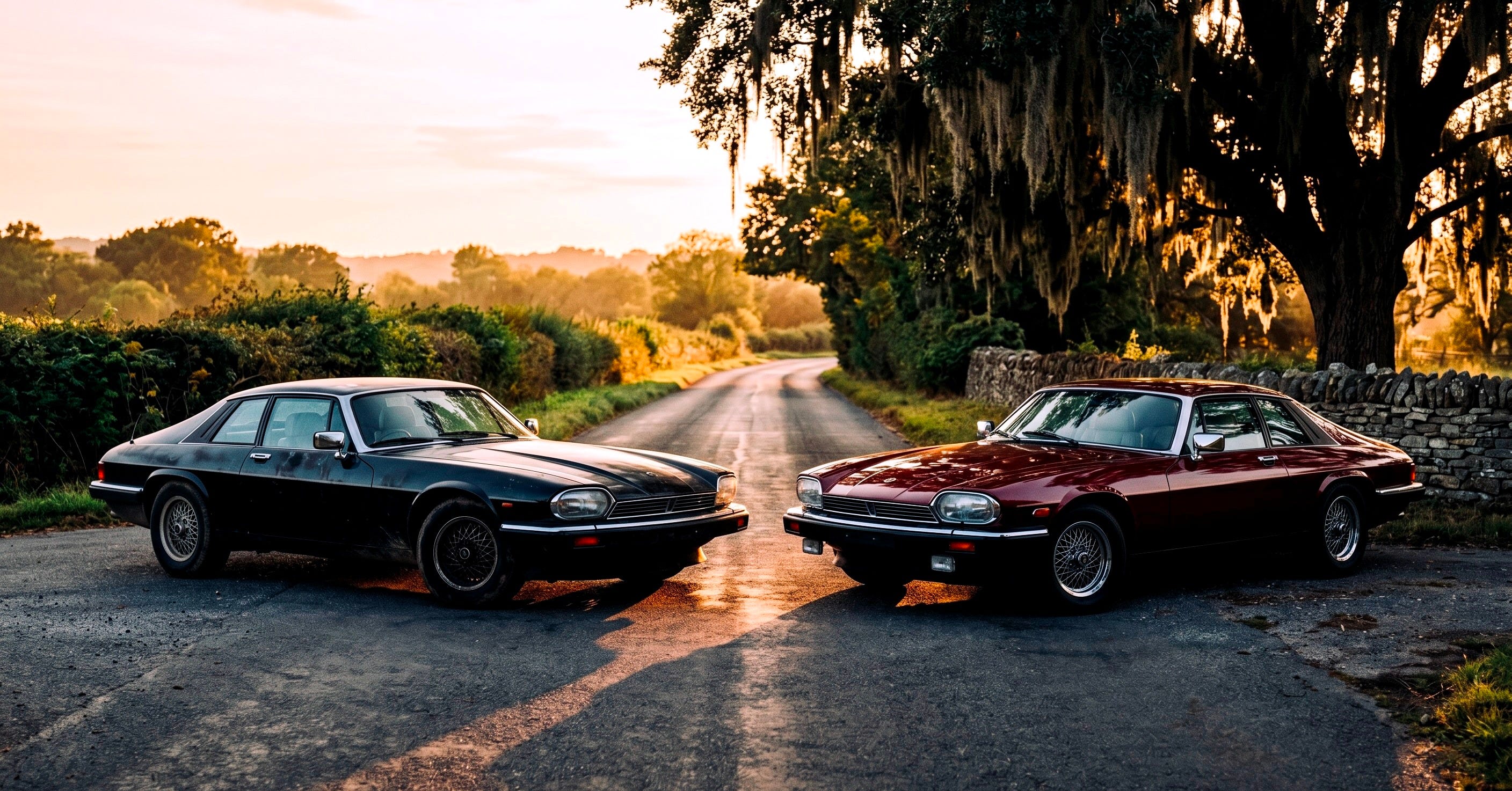
Picture two cars. Same model, same body shape, same fundamental machine. The first is parked on a Cotswolds lane, dark paint against honey-coloured stone, the kind of scene that looks arranged but isn’t. The second sits under live oaks somewhere in coastal Georgia, its burgundy paint warm against the Spanish moss and the stillness of the American South. Same car. Entirely different meaning.
This is the Jaguar XJS, and no car illustrates the strangeness of cultural translation quite so cleanly.
When Jaguar launched the XJ-S in September 1975, they were doing something almost impossibly difficult: replacing the E-Type. The E-Type had arrived in 1961 to universal acclaim, a car so immediately and completely right that Enzo Ferrari, not a man given to praising his competition, was said to have called it the most beautiful car ever made. Fourteen years later, Jaguar’s answer to the question of what came next was a heavyweight grand tourer with prominent rear buttresses, a 5.3-litre V12, and a price that had almost doubled from the car it replaced.
Britain did not take this well.
The criticism was immediate and personal. The buttresses were ugly. The tail was wrong. The whole car felt like a betrayal of everything the E-Type had stood for. What Jaguar’s critics chose not to acknowledge was that the buttresses were there for a reason: Malcolm Sayer, the aerodynamicist who had shaped the early design before his death in 1970, had included them to manage airflow over the car’s rear at speeds above 150 miles per hour. The XJS was not a sports car wearing a touring car’s body. It was a grand tourer designed from first principles, using the platform of Jaguar’s acclaimed XJ saloon, built for covering large distances at sustained high speed in exceptional comfort. The brief had changed. Britain had not yet accepted the change.
In America, nobody was mourning the E-Type. The E-Type had always been slightly abstract in the United States, admired from a respectful distance, too raw for the long straight roads and too European in its demands for a market that had grown up differently. The XJS was something America understood immediately: a V12 producing 285 horsepower, a grand touring coupe with leather and genuine wood, capable of exceeding 150 miles per hour, priced below the Germans and the Italians. Jaguar had not replaced the E-Type in American eyes. They had built a different car for a different purpose, and that car was exactly what was wanted.
Through the late 1970s and into the 1980s, the XJS sold steadily in America on the strength of its V12 while struggling in Britain under the weight of a reputation as a car that should have been something else. Sales dropped to just over a thousand units worldwide in 1980, and there were serious discussions at Browns Lane about discontinuing it entirely. Jaguar chose instead to develop it. The High Efficiency V12 arrived in 1981, improving fuel economy without compromising power. A six-cylinder AJ6 variant followed in 1983, along with a cabriolet. By 1988, a full convertible was in the range, and something shifted. The XJS in open-top form looked, suddenly, like the car it had always been trying to be. The criticism softened. Britain, slowly and somewhat grudgingly, began to come around.
But the two cars in the two countries were never quite the same experience. The American XJS was almost exclusively the V12 automatic. Smooth, effortless, the engine barely perceptible at speed, the whole car oriented toward covering ground rather than the engagement of driving. Jaguar did not offer the six-cylinder manual in the United States until the 1991 facelift, and even then in limited numbers. The American XJS was a cruiser in the finest sense of the word, and it suited the coastal Georgia landscape, the long highway on-ramps, the wide boulevards of Southern cities, as though the engineers had known exactly where it would end up.
The British car was something different. Driven on narrow lanes with real gradients and genuine corners, with weather that changed unpredictably and roads that made demands the American market never imposed, the XJS revealed a character the smooth surfaces of the South sometimes concealed. More demanding than it appeared. A driver’s car in the honest sense: it rewarded attention and punished inattention, quietly, without theatrics, in the manner of a car built by people who understood that competence and drama are not the same thing.
The burgundy car under the Georgia oaks is making a statement. Someone chose it deliberately, in a country where it has no ancestral claim, no inherited meaning, no obligation to be compared with something it replaced. It carries the romance of the foreign object, English in the way only things at a distance from England can be.
The black car in the Cotswolds is under different pressure. It spent decades being forgiven for not being its predecessor, and it wears that history as part of its character now. It belongs there the way complicated things belong somewhere: not seamlessly, but honestly, with everything it has been through visible in how it sits.
By the time the last XJS rolled off the production line in April 1996, Jaguar had built 115,413 of them, more than the E-Type, the car its critics had never allowed it to forget. It had survived 21 years, two ownership changes, an energy crisis, and a reception that would have ended most cars inside a decade. In Britain it is now a classic with a complicated past.
In America it was always just a very good car.
Same car. Entirely different story.
The Road & Soul. Cars, cultures, and the road between.