

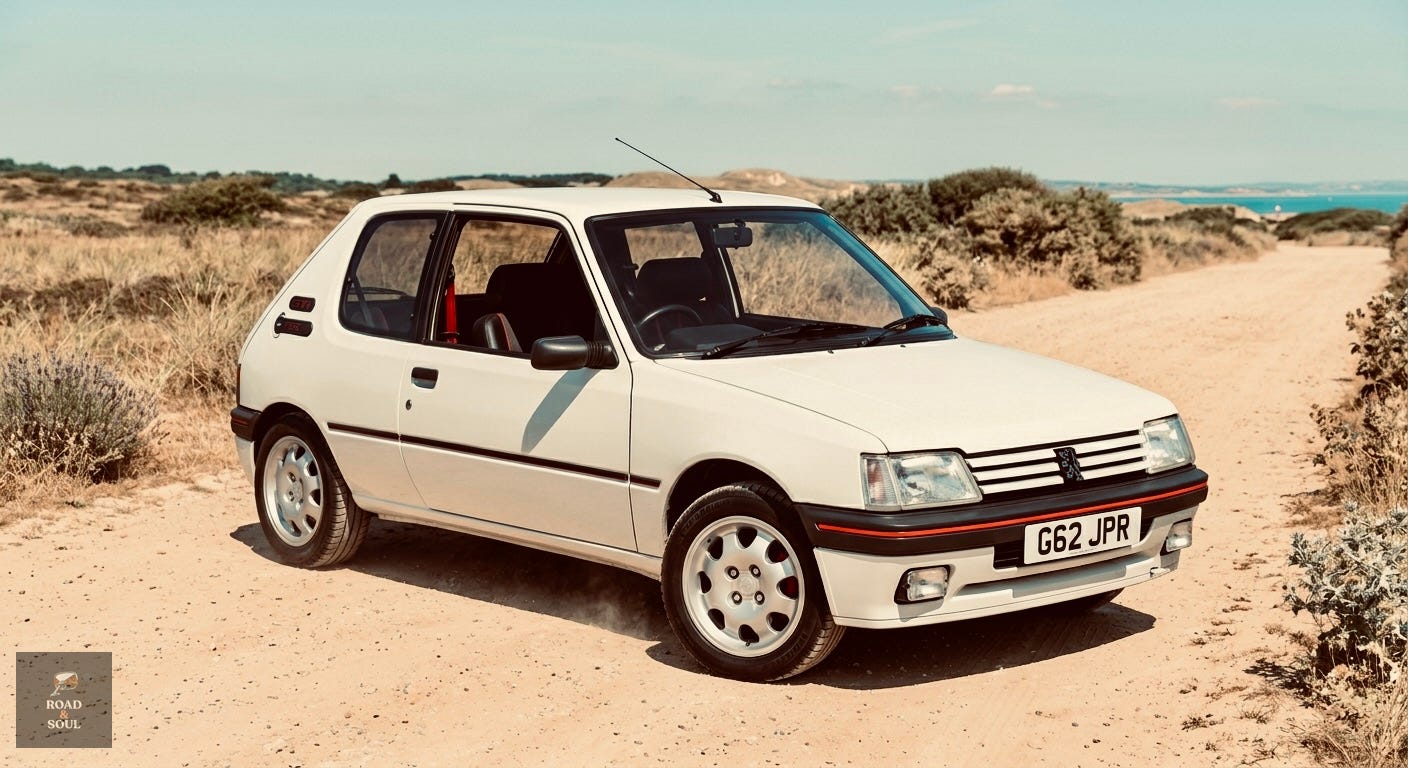
There is a photograph doing the rounds. You’ve probably seen it, or one like it. A 205 GTI, Blanc Meije, parked on some French B-road in what looks like 1987. Long shadows, someone leaning against the door, the composition accidental in the way only unposed photographs manage. It has been shared, saved, and commented upon by thousands of people, a significant proportion of whom were not yet born when it was taken.
The 205 GTI has become a car people love from a distance. Through photographs and auction catalogues and asking prices that would have seemed deranged to anyone who actually ran one through a winter. The nostalgia is real. You can feel it in the room whenever a clean one turns up at a show, a small crowd gathering with a reverence that was never part of the car’s original job description. But it is, increasingly, nostalgia for a life that most of its admirers never actually lived. A borrowed feeling. An inherited ache for something they were not there to lose.
I owned a 205. Not a GTI, but a standard car, a 1.4, in a colour I could charitably describe as neglected. It didn’t go especially fast and it didn’t need to. What it did was feel alive in a way that its size had no business suggesting. The steering had weight and opinion. The body rolled into corners without collapsing into them. The gear lever moved with a precision that felt direct and mechanical, unmuffled, as though someone had trusted you enough to manage the exactness yourself. Even the door had a quality to it, the weight and the sound it made closing, that belonged to a car built by people thinking about the small things. It was a very good small car and I loved it the way you love things that work exactly as they should without making a fuss about it. It died, in the end, an electrical death. Which, for a French car of that generation, was not really a surprise. It was practically a tradition.
I also drove a GTI. Borrowed, briefly, on roads I knew well enough to push it properly. The difference between the standard car and the hot one was less in quantity than in character. A heightened version of the same conversation rather than an entirely different argument. The 205 always felt like it was talking to you; the GTI talked faster and expected more back. The front end bit into corners with genuine intent. The steering, already good, became urgent. At the limit it wanted your complete attention, and it asked for it without apology. It wasn’t forgiving in the way modern performance cars are forgiving. There was no invisible corrective hand. But it was honest, and honesty in a car is a different quality to safety entirely.
What I remember most is something ordinary: driving it home one evening on a road that didn’t deserve it, the low sun through the windscreen at the angle that makes everything look as though it was lit for a film. Forward motion on imperfect roads, in changing light, with something to prove. No screens. No modes. No car quietly overriding your inputs in the name of your wellbeing. It went where you pointed it and asked you to take responsibility for what came next.
Inside, the 205 GTI wore its intentions plainly. The bucket seats held you without ceremony. The dashboard, designed in a period when French interiors were permitted to be genuinely eccentric, had a three-spoke steering wheel with no airbag, thin-rimmed and direct in the hands, the kind that’s since been regulated out of existence. The instruments told you what you needed to know. Nothing explained itself. It assumed you already knew.
The people sharing that white 205 on Instagram were not there for any of this. They have assembled their own relationship with the car from fragments: a childhood passenger memory, perhaps, or a magazine photograph, or the accumulated gravity of a reputation built over four decades. What they are mourning is not really a car. It’s a set of conditions that made the car possible.
Peugeot in the early 1980s was doing something that feels almost foreign now. France, for a moment, was making things the rest of the world actually wanted: clothes, films, ideas, and, not incidentally, cars. The 205 arrived in 1983 as evidence of a company that had found its confidence again after years of missteps. A Peugeot design through and through, the coachwork has aged with a composure very few small cars manage. The proportions were right then and they are right now, which is either fortunate coincidence or evidence that proportion, done properly, doesn’t date. The GTI added aggression without disturbing the line: a discreet body kit, correct alloys, a grille with intent. A designed object rather than a decorated one. Everything where it should be, nothing added for the sake of addition.
More than the design, the car carried a confidence its era permitted and the current era does not. Here was a manufacturer willing to take its smallest, cheapest car and make it better: proper suspension, a willing engine, and the restraint to leave everything else alone. No performance tier. No option package. Just: here is more of what the car already was. That logic has become rare enough to feel remarkable in retrospect.
It asked something of you and you knew it. There was a generation of people who learned to drive properly because of it, who understood oversteer not as an event to be managed by electronics but as information to be used. Cars have largely stopped making this demand. Whether that is a loss or a change depends, I suppose, on what you think driving is for.
The nostalgia surrounding the 205 GTI is not dishonest. You don’t need to have owned something to mourn the world that made it; grief can attach itself to objects that stand in for conditions you wished you’d been part of, and that wish is a genuine response to something real. But there is a difference between knowing a thing and loving its legend, and anyone who actually ran one of these cars, who knew its stubbornness in slow traffic, who paid the insurance, who loved it despite and because of all of that, knows where the difference lies.
The car deserves every word written about it. It deserves the prices it now commands and the slow pilgrimages made to the good ones that occasionally surface. But it also deserves to be remembered as what it was before it became what it is: a small French car, made without sentiment, that happened to be exactly right, and had no idea that this would one day matter so much to so many people who were not there.
The Road & Soul. Cars, cultures, and the road between.